Blackjack expected value is the average net result in a specified probability model, not a prediction of the next hand. There is no single answer for every table: the rules, payouts, cards, player decisions and any fees matter. A casino can have an advantage on average while a player wins a hand or finishes a session ahead.
The blackjack rules guide explains play. Here the question is how probabilities and net outcomes combine, and what a calculation can and cannot tell you.
How does a casino make money from blackjack?
In a model with negative player expected value, the average net result is a loss. The opposite amount, expressed relative to a specified wager base, describes the house edge. It is not a fee taken from every hand: a hand can win, lose or push. The UK Gambling Commission explains house edge as an average under a model, not a guaranteed result for an individual session.
To calculate expected value, multiply each possible net result by its probability and add the products. Include every final outcome, the decision policy, extra wagers and fees. If expressing the result as a percentage, specify the wager base and treatment of additional stakes. A returned stake is not profit: a push has zero net result. Gross return includes money returned, while net result deducts the money wagered.
Without a complete model, the honest answer to “what is the expected value of blackjack?” is unknown. A payout or a probability for one hand alone cannot establish the whole-game edge.
Which rules and decisions change the calculation?
- Payouts and settlement: natural blackjack, other winning hands and pushes may be treated differently. Side bets have their own terms and outcomes.
- Player decisions: hitting or standing changes the distribution of later outcomes. Splitting and doubling, when permitted, also change the amount at risk; surrender changes settlement.
- Dealer rules: S17 means the dealer stands on soft 17; H17 means the dealer hits it. A numeric comparison needs a complete set of rules and a defined decision policy.
- Decks and dealing: deck count, known cards and dealing without replacement affect the distribution. Deck count alone does not determine an edge.
- Fees and side bets: include their amounts and conditions in any model that claims to describe the full result.
Basic strategy chooses actions for a specified ruleset and available information; it does not predict the next card. A chart needs its deck count, dealer soft-17 rule, split and double conditions and surrender rules to be meaningful. Even correct basic strategy does not guarantee profit or necessarily remove the house edge.
Natural blackjack, ordinary 21 and payouts
A natural is an initial two-card ace and ten-value card. An ace can count as 1 or 11 without busting; an ace and two tens total 21 with the ace counted as 1. A three-card 21 is not a natural. Settlement depends on the rules: in the historical British rules cited below a player’s natural beats a dealer’s three-card 21, but two naturals push. Those rules are not a claim about every current game.
For a hypothetical $10 initial wager, no fees and a winning natural, payout ratios specify net profit; the returned stake is included in gross return:
| Settlement | Net result | Gross return |
|---|---|---|
| Natural at 3:2 | +$15 | $25 |
| Natural at 6:5 | +$12 | $22 |
| Ordinary win at 1:1 | +$10 | $20 |
| Push | $0 | $10 |
| Loss | −$10 | $0 |
The 6:5 natural pays $3 less profit than 3:2 on that wager. This comparison is not a whole-game edge: it says nothing by itself about how often a natural wins or other outcomes. A reproduction of New Jersey rules describes both payout variants within that jurisdiction; it does not establish the rules of any particular table elsewhere.
Probability of the initial two cards
Consider a teaching model: one complete standard deck, uniformly random order, no cards previously dealt, and the player’s first two cards sampled without replacement. This is the initial-hand perspective, before seeing or conditioning on a dealer card or a dealer peek; there is no split. There are four aces and 16 ten-value cards. Either order gives an ace and a ten-value card:
4/52 × 16/51 + 16/52 × 4/51 = 32/663 ≈ 4.83%.
This is the probability of that initial combination, not the probability of winning the round. The dealer may also have a natural, and settlement depends on the rules. The formula does not include the dealer’s outcome, subsequent actions, extra wagers or fees, so multiplying it by a payout does not give game expected value.
Without replacement, a known exposed card changes the composition available for subsequent draws. Unknown cards have still been removed physically, but cannot simply be treated as known ranks. Conditional probabilities must reflect exactly what is observed and the dealing sequence; conditioning on a dealer peek is a different information state from the initial model above. Neither a changed probability nor a count of visible cards identifies the next card.
Card counting uses information about cards already seen to estimate a changing composition, not to predict a particular card. Its value depends on the full rules, remaining cards and decisions; it is not universally profitable and does not guarantee a session win.
Does a win prove a player advantage?
No. A lucky hand is possible under negative expectation; a short streak does not establish long-term profit. A losing streak does not make a win due, and increasing a wager does not itself improve card probabilities. More money can be lost. The casino profit guide distinguishes a win from reliable income.
Expected value is an average, not a session forecast. RTP and volatility explains the difference between average return and variation, but its slot examples are not blackjack calculations. A house edge also does not by itself prove manipulation: game fairness is a separate question.
Sources and scope
The following saved source texts were read again for this adaptation; they were downloaded for earlier articles on 26 November 2026, not freshly fetched. They do not audit a casino or establish current rules everywhere:
- The Gaming Clubs (Bankers’ Games) Regulations 1994, regulation 7 as made: a primary historical British example of natural settlement, pushes and 3:2 payout; not a statement of current law or all games.
- UK Gambling Commission: RTS 3, updated 7 May 2024: information on game rules, payouts and likelihood within its applicable British framework.
- New Jersey Administrative Code 13:69F-2.3, reproduced by Cornell LII: a secondary reproduction of jurisdiction-specific rule text describing 3:2 and a 6:5 variation, not an official primary host or a universal rule.
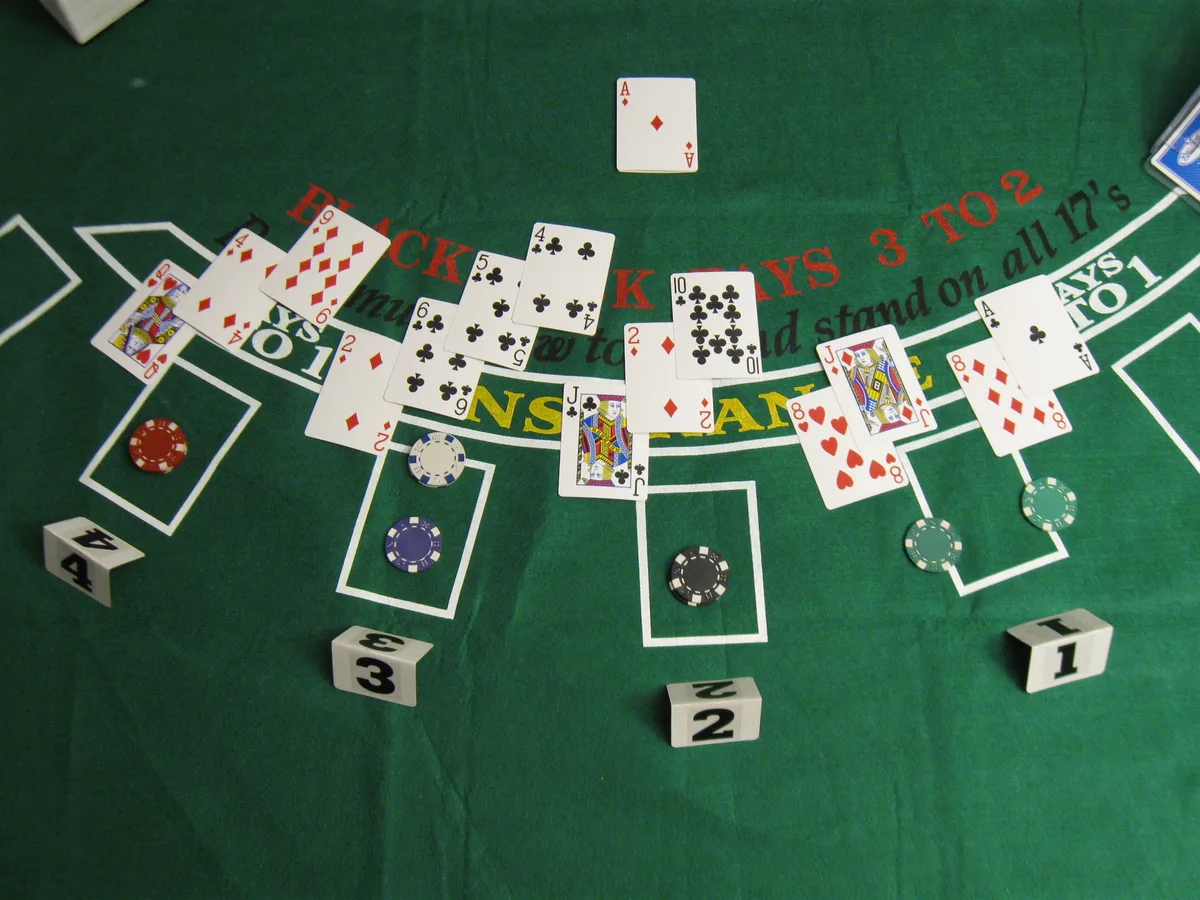
The one-deck probability example is independent of those historical rules and does not reproduce a complete game. The photograph illustrates cards and chips, not a particular table’s terms.