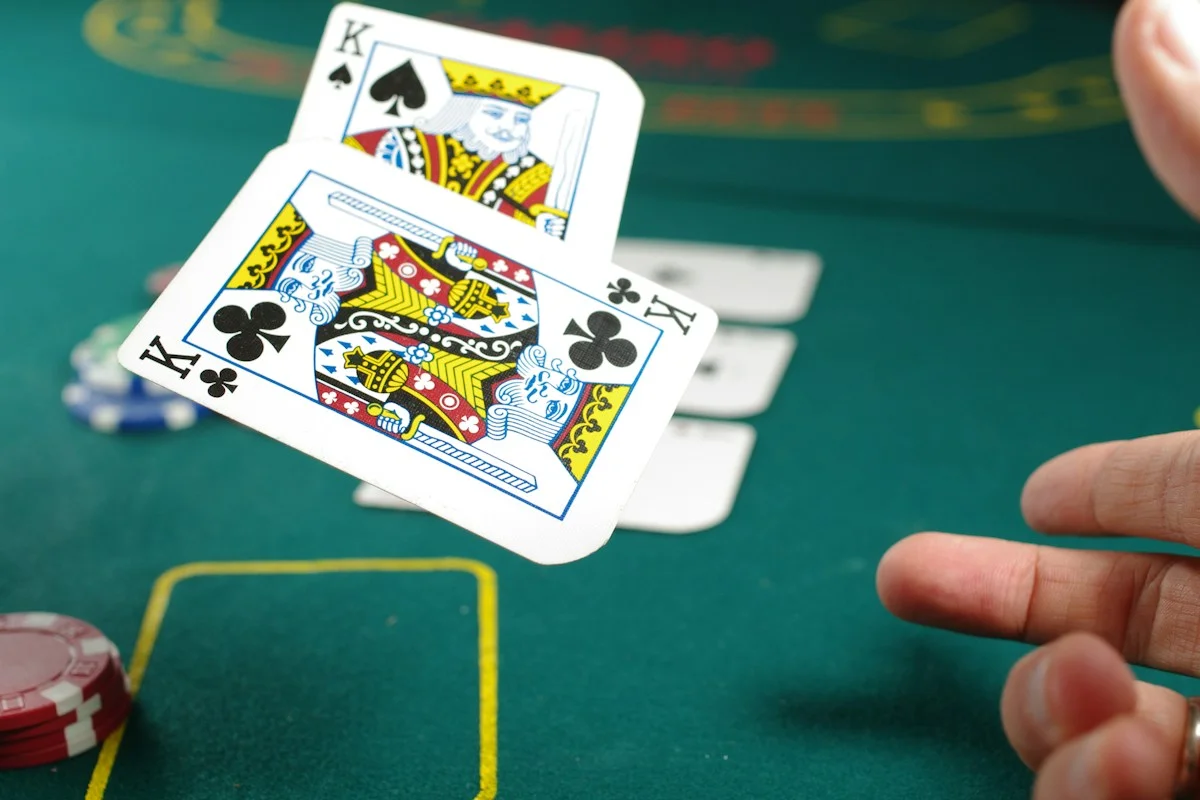
In blackjack, the aim is to beat the dealer without going over 21. You do not have to reach 21: a hand of 19 beats a dealer’s 18. Each player plays against the dealer, not the other players. Going over 21 is a bust, and a busted hand loses.
The rules below describe common versions, not every table. Check the particular game’s deal, payouts and permitted actions before playing.
What are the cards worth?
Blackjack commonly uses one or more standard 52-card decks without jokers. Suits do not affect the main hand’s total.
| Card | Value |
|---|---|
| 2 through 10 | Face value |
| Jack, queen, king | 10 each |
| Ace | 1 or 11 |
A queen and a seven make 17; two nines make 18. Unlike in some other card games called 21, a jack is not worth 2 and a queen is not worth 3 in blackjack.
When does an ace count as 1 or 11?
Count an ace as 11 when that does not bust the hand; otherwise count it as 1. The useful value can change when another card is dealt:
- Ace and six: 7 or soft 17.
- Ace, six and nine: 16, with the ace counting as 1.
- Two aces: 12, with one counted as 11 and the other as 1.
- Two aces and nine: 21 (11 + 1 + 9).
A soft hand has an ace that can count as 11 without busting. A hard hand does not: ten and seven is hard 17, as is ace, six and ten, where the ace counts as 1.
What is a natural blackjack?
A natural blackjack is 21 on the initial two cards, an ace and a ten-value card: a ten, jack, queen or king. Seven, five and nine also total 21, but are not a natural. A natural normally beats an ordinary 21 and has a separate payout; two naturals normally push. Check the table’s rules.
An ace and ten-value card after a split are usually an ordinary 21, not a natural. Split-hand and payout rules can vary.
How does a round work?
- Place the initial wager before the deal. Later increases are limited to actions allowed by the rules.
- The player receives two cards. In one common deal the dealer has one visible card and one face-down card; in other versions the dealer’s second card is dealt later.
- The player chooses among available actions. A dealer blackjack may be checked and settled before further play, depending on the deal and rules.
- The dealer completes the hand according to fixed table rules, rather than choosing freely like the player.
- Each hand is settled under the game’s rules.
A player who busts loses that hand even if the dealer later busts. A dealer bust normally wins for the remaining hands that have not busted, subject to the table’s settlement rules.
What do hit, stand, double, split and surrender mean?
- Hit: take another card. If the hand has not busted, another choice is usually available.
- Stand: take no more cards on that hand.
- Double down: when allowed, increase the wager, usually to twice its original amount, and receive exactly one more card. Eligible totals and timing vary.
- Split: when the initial cards qualify, separate them into two hands, usually with an equal additional wager.
- Surrender: if offered, give up the hand and recover half the wager under the table’s conditions. It may be allowed before or after a dealer blackjack check, or not offered at all.
How does splitting work?
Suppose a hypothetical $10 wager receives two eights. Splitting requires another $10 in this example: each eight starts a separate $10 hand, for $20 in total at risk. One hand can win while the other loses. Splitting is not a free extra attempt.
Check whether different ten-value cards can be split, how many hands and resplits are allowed, whether doubling after a split is available, how many cards split aces receive, and how a resulting 21 is settled. These conditions differ by table.
What are S17 and H17?
The dealer usually hits on 16 or less and stands on hard 17 or more. Soft 17, such as ace and six, depends on the rule:
- S17: the dealer stands on soft 17.
- H17: the dealer hits soft 17.
The difference changes the game’s mathematical conditions. “The dealer always stands on 17” is not true at every table.
How are hands and payouts settled?
For ordinary hands still in play, the higher total wins without exceeding 21. Equal totals normally push: the original wager is returned. A natural and an ordinary 21 are not normally equal for settlement. Check the specific rules, including exceptions for particular variants.
The following hypothetical $10 examples assume the stated payout, no side bets, splits, doubles or fees, and a winning natural where shown. A payout ratio describes profit, not the total returned with the original stake.
| Result | Net result | Total returned including stake |
|---|---|---|
| Ordinary win at 1:1 | +$10 | $20 |
| Natural win at 3:2 | +$15 | $25 |
| Natural win at 6:5 | +$12 | $22 |
| Push | $0 | $10 |
| Loss | −$10 | $0 |
A 6:5 natural pays less than 3:2 on the same wager. Neither rate is universal; read the table’s payout and settlement terms.
What is insurance?
Insurance is an optional separate wager, commonly offered when the dealer’s visible card is an ace. It bets that the dealer has a natural blackjack. Under common rules the insurance wager can be up to half the original wager and pays 2:1 if it wins. If the dealer does not have blackjack, insurance loses regardless of the eventual main-hand result. It does not protect against every loss; availability and settlement depend on the game.
Is blackjack the same as 21 or Russian ochko?
“21” can be another English name for blackjack, but it can also refer to a different game. Russian ochko is a family of home-game variants, not automatically casino blackjack. Some use a 36-card deck and different values for picture cards; ace values, order of play, the bank and special hands can also depend on the agreed version. Compare the actual rules rather than treating any one home version as universal.
Does basic strategy guarantee a win?
No. Basic strategy selects actions using a specified set of rules, the player’s hand and the dealer’s visible card; it does not predict the next card. Deck count, soft-17 rule, doubling and surrender conditions can change the appropriate decisions. A strategy chart without its assumptions is not a universal answer.
Even correct strategy does not guarantee profit or necessarily eliminate the house advantage. A numerical house edge requires a complete model of the rules and play; increasing a wager after a loss does not make the next outcome more favorable.
Where can you learn without money?
Use a deck and valueless practice chips to work through hands and dealer actions. A demo game may help with controls, but verify that its balance is virtual and check its own rules. A demo neither predicts real-money results nor establishes that money play is lawful in your location or bypasses age restrictions.
Before choosing a table, check the natural payout, dealer soft-17 rule, split and double restrictions, and minimum and maximum wagers—not just the name “blackjack.”
Sources and scope
- Bicycle Cards: Blackjack, accessed 26 November 2026, describes one common game, not all casino variants.
- The Gaming Clubs (Bankers’ Games) Regulations 1994, regulation 7 as made, accessed 26 November 2026, describes a specific historical UK version. It is not a statement of current law or US rules.
- New Jersey Administrative Code 13:69F-2.3, reproduced by Cornell LII, accessed 26 November 2026, describes both 3:2 and a 6:5 variation within that jurisdiction. It does not establish rules for every table.